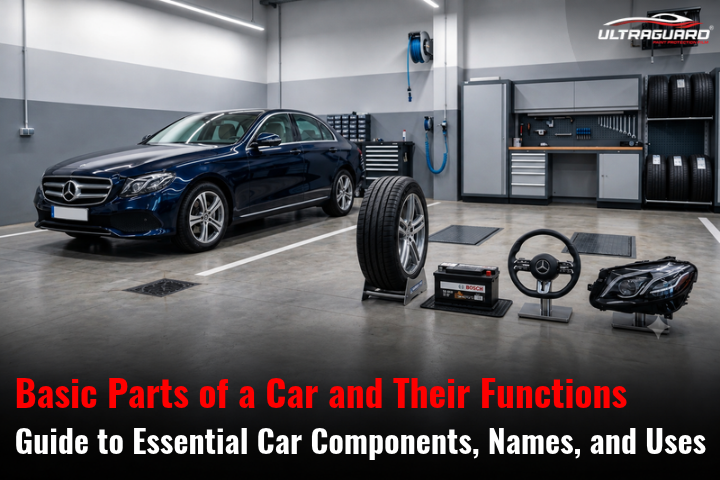
Basics of Car Parts and Their Functions
Here is an easy breakdown of the simple parts of a car. 1. Engine and Driveline Motor Each car has an engine, a power generator in its heart. Most modern vehicles use an Internal Combustion Engine (ICE), usually four, six, or eight-cylinder engines in inline or V-configuration.- Cylinder block: The main structure of the main block, where the stamps flow up and down.
- Pistons: Cylindrical elements that transfer energy from combustion to rotational speed.
- Crankshaft: Converts the linear movement of the piston into rotational energy.
- Connecting Rods: Attach the piston to the crankshaft.
- Cylinder Head: Houses valves, spark plugs (in a petrol engine), or a fuel injector (in diesel or direct injection).
- Valves and Camshaft: The intake valve allows air/fuel in; the exhaust valves bring out the burnt gases, which are generally activated by a camshaft.
- Fuel System: Fuel pumps, injectors, carburettor, and fuel rails are incorporated. Distributes fuel under proper pressure.
- Ignition System (petrol engine): Spark plugs, ignition coils, distributors or electronic systems to fire at the right time.
- Cooling System: Place the engine with the water pump, radiator, thermostat, and coolant hoses to prevent overheating.
- Lubrication System: Oil pumps, filters, and roads lessen the friction, avert heat and extend life.
- Exhaust System: Exhaust manifold, catalytic converter, muffler, tailpipe, and clean exhaust gases.
- Electric motors change or add to the engine.
- A battery pack stores electrical energy.
- Power Electronics elements convert the DC battery power to AC for the engine, and vice versa for regenerative braking.
- The regenerative braking system brings back the energy that would otherwise be wasted and charges the battery.
- Clutch (manual): connects/disconnects the engine from the transmission.
- Gearbox: Shifts torque and speed. Manual gearboxes require manual shifting; automatic transmissions use huge gear kits.
- Torque converter (automatic): The fluid coupling between the engine and the gearbox allows a smooth start.
- Continuously variable transmission (CVT): Uses belts and pulleys to offer seamless ratio changes for better regulation.
- Drive shaft/shaft: Transfers power from the gearbox to the wheels.
- Fuel Tank: Stores gasoline or diesel.
- Fuel Pump: Usually electric, pushes fuel to injectors.
- Fuel Filter: Removes debris before it reaches the fuel injector.
- Fuel injector (or carburettor): Distributes accurate amounts of fuel for the intake air stream.
- Air filter: Averts dust/debris from entering the engine.
- Mass Air Flow (MAF) sensor or Manifold Absolute Pressure (MAP) Sensor: Monitor the air flow in the engine.
- Throttle body: The throttle body controls the air intake through the plate, usually connected to the accelerator pedal electronically, either by wire or mechanically.
- Exhaust Manifold: Collects exhaust gases from the cylinders into one pipe.
- Catalytic Converter: Changes harmful gases (carbon monoxide, nitric oxide, hydrocarbons) into less dangerous materials.
- Oxygen sensors (O2 sensors): Monitor the exhaust gases, allowing optimal combustion by responding.
- Muffler (Muffler): Lessens noise and sets the exhaust tone.
- Radiator: Shifts the warmth from the coolant to the ambient air.
- Water (coolant) Pump: Moves the coolant through the engine and radiator.
- Thermostat: Controls the coolant flow via temperature.
- Cooling Fan: When the automobile is at low speed, the air is pulled through the radiator.
- Radiator Hoses: Attach the component and allow coolant to flow.
- Heater core: Uses warm air to heat the cabin air with the help of the blower fan.
- A/C compressor: Compresses refrigerant.
- Capacitor: Releases warmth from refrigerant to the outside air.
- Evaporator: Soaks up the cabin warmth from the air.
- Expansion valve or orifice pipe: Controls the refrigerant pressure flow.
- Blower Motor: shoves climate-controlled air into the cabin.
- Control and Sensor: A Manual or automatic weather management system that adjusts temperature, airflow, and weather regions.
- 12-volt battery (or high voltage in EVs/Hybrid): Gives power to start the engine and electrical systems.
- Starter Motor: Involves cranking the engine to the flywheel.
- Alternator: Charges the system and battery while the engine runs.
- Tension Manipulation: Manages stable engine voltage output.
- Vehicle wiring harness: Joins sensors, actuators, lights, and modules.
- Engine Control Unit (ECU)/Powertrain Control Module (PCM): Manages fuel injection timing, ignition timing, specified speed, emissions, etc.
- Body Control Module (BCM): Overlooks body electronics, wipers, lights, locks, windows, etc.
- Sensors: Incorporates coolant temperature sensor, crankshaft position sensor, throttle position sensor, oxygen sensor, wheel speed sensors (ABS), airbag impact sensors, etc.
- Headlights (halogen, HID, LED), brake lights, taillights, turn indicators
- Dashboard things: Shows tachometer, speedometer, fuel gauge, warning lights, and infotainment screen.
- Infotainment structure: Touchscreen, navigation, media player, smartphone integration.
- Power accessories: Power windows, locks, and mirrors.
- Springs: Spool springs or leaf springs assist with weight and soak up the shock.
- Shock absorber/struts: Mute the continuous bounce.
- Control arms, bushings, ball joints: Connect the chassis to wheels, maintain structure and ride quality.
- Stabilizer bar (sway bar): Limits the body roll from cornering by linking the right and left wheels.
- Attach wheel and columns: Driver interface to steer.
- Racks, pinions, or recirculating ball control gear: Converts column rotation to wheel direction change.
- Power steering pump (hydraulics) or electric motor (EPS): Provides help with easy control.
- Tie Rods: Attach the steering gear to the wheels.
- Brake pedal: Transfers the driver's pressure to the braking system.
- Master cylinders and brake amplifiers: Increase the pedal force (with vacuum assistance or electrical assistance).
- Brake lines and hoses: Move hydraulic brake fluid.
- Calipers, brake pads (disc brakes) or wheel cylinders, brake shoes (drum brakes): From frictional surfaces to slow wheels.
- Rotor or drum: Rotating disc or drum surfaces against which shoes/brake pads press.
- Anti-Lock Brake System (ABS): Wheel speed sensors and electronic structure prevent wheel locks while heavy braking.
- Electronic Brake Force Distribution (EBD): Adjusting brake force among the front and rear wheels according to the weight.
- Wheels (Rims): Support tire structures, give power and brake forces.
- Tires: Give street contact, grip, cushion, and traction. Types incorporate all seasons: summer and winter.
- Tire pressure monitoring system (TPMS): Warns when the pressure is reduced.
- Heel Naves and Save: Gives a smooth wheel rotation and supports vehicle weight.
- Unibody or Body-on-Frame: Structural setup of the car; Unibody integrates the body and frame, while the body-on-frame separates them.
- Subframe structures: Growing points on motors, transmission, and suspension components.
- Doors, hood (hood), luggage compartment (boot), fender, and ceiling bumper: External styling and access panels.
- Crumple zones: An Engineered Region that deforms in a collision to absorb energy.
- Side effect rays, airbags, seat belt sanders: Protect people in accidents.
- Reinforcement (column A/B/C supports columns): Maintain cabin integrity.
- Display screen: Dash and centre console for navigation and entertainment.
- Speaker, microphone: Audio playback and voice control.
- Bluetooth/Wi-FI connection: Hands-free calling and music streaming.
- GPS module: Navigation and traffic updates in real time.
- Telematics system: Provides emergency response, vehicle diagnosis, and remote control.
- Windshield wipers and wipers: Improve visibility.
- Windshield and windows (glass): Provide visibility and cabin separation.
- Mirrors (rear-view, side-view): Help you see around the vehicle.
- Horn: Safety warning unit.
- Packages and seals: Keep the liquid (oil, coolant) and air sealed in the system.
- Hoses, belts, chains: Drive accessories (generator, compressor), connect components, transfer fluids.
Common Car Issues and Warning Signs You Should Never Ignore
Understanding the main parts of a car allows you to diagnose general problems and help in interaction with mechanics:- Overheating: Thermostat errors, coolant leakage, a defective water pump, or a faulty radiator may be the cause.
- Poor gasoline economy or rough idle: Clogged fuel injectors, dirty air filters, a faulty oxygen sensor, or poor spark plugs may be associated.
- An unstable ride or steering: This can cause suspension, worn shocks/struts, or uneven tire wear.
- Hanging noise whilst braking: This can mean trouble with warped rotors, worn-out pads, or ABS sensors.
- Starting problems or gradual lighting issues: Possibly a weak battery, a failed alternator, or a corroded battery/cable.
- Electric glitter: Delicate grounding, failing sensor, or failing BCM can cause infotainment, lighting or door lock failure.
Basic Car Maintenance Tips Every Car Owner Should Follow
- Standard oil and regular oil changes: Every 5,000–10,000 km or according to the manufacturer's plan.
- See belts, hoses, air and gas filters: Change before blunders.
- Brake fluid, monitor coolant, transmission fluid: Top up or flush as needed.
- Check the tire pressure and tread depth: Make a goal for PSI and change the tire before the tread depth drops below a specific margin.
- Replace brake pads or footwear in time: Prevent rotor or drum damage.
- Check the suspension component/ steering alignment annually.
- Sometimes the diagnostic scan runs, especially when your “check engine" light is on.
- Clean or update battery terminals; Check the charging gadget once a year.
- Keep plumbing gadget service: Cabin filter out, refrigerant charge, and blow motor function.
How Automotive Engineers Design Cars for Safety, Performance, and Comfort
Modern cars mirror the result of a balanced economy, safety, comfort, emissions, cost, and reliability.- Reliability: Motors use strengthened alloys in engine blocks, firm electronics, and corrosion-resistant coatings.
- Efficiency: Fuel injections, turbochargers, CVTs, and hybrid compositions accelerate the economic system.
- Safety: Integrated Electronics, crumple zones, and sensor systems lessen the harm.
- Emissions: Catalytic converters, EGR valves, and precise engine control limit pollutants.
- Relaxation and convenience: Climate control, infotainment, and a packed interior make driving more comfortable.
Essential Automotive Terms Every Car Owner Should Know
Below is the table of definitions of some significant terms:| Term | Definition |
| Crankshaft | Rotates to turn piston motion into torque. |
| Camshaft | Opens and closes valves synchronously. |
| Differential | Allows wheels to spin at different speeds in a turn. |
| Torque multiplier | In automatics or CVTs, it helps with torque and smoothness. |
| ECU / PCM | Main computer controlling the engine and drivetrain. |
| ABS | Anti‑lock Braking System to prevent wheel lock‑up. |
| TPMS | Tire Pressure Monitoring System alerts to low tire pressure. |
| HVAC | Heating, Ventilation, and Air‑Conditioning system. |
| Regenerative braking | EV/hybrid systems recover energy during deceleration. |
How Emerging Technologies Are Changing the Future of Cars
- Electrification: Electric Vehicles (EVS) continue to grow - no ICE, many motors, large battery packs, and fewer moving parts.
- Adoption: Mild and plug-in hybrid powertrain integrates motors and engines.
- Autonomous System: Latest sensor suites—Lidar, Radar, Camera—drive self-driving features and Safety Automation.
- Connected Cars: V2X communication (from vehicle to vehicle and vehicle to infrastructure) enhances traffic flows, safety alerts, and over-the-air updates.
- Lightweight Materials: aluminum, carbon fibre, and high-strength steel for efficiency and crash resilience.
- Active Aerodynamics: Grilles and spoilers adjust for flying, cooling, and drag reduction.