What is Car Window Tinting?
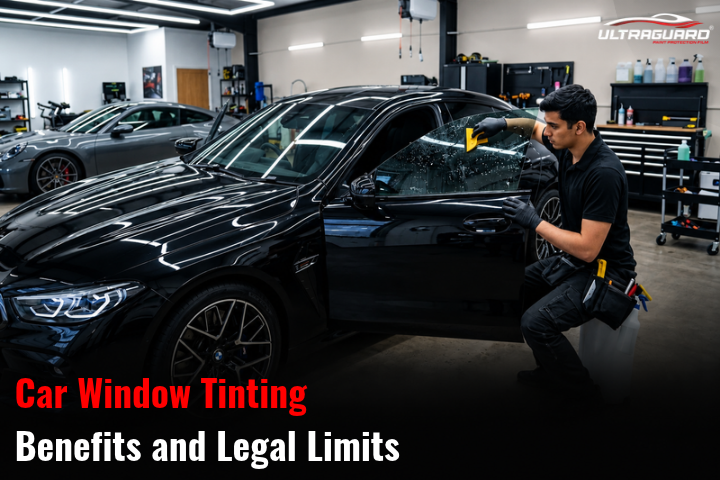
Car window tinting is one of those upgrades you’ll appreciate every single day. It’s just a thin film that goes onto the glass, but it makes a real difference. Your car stays cooler when it’s parked in the sun, the glare doesn’t hit you in the eyes as hard, and the UV rays that slowly fade your seats and dashboard get blocked out. You also get a bit of privacy, so people walking past can’t just peek inside. There are a few types of film out there, like nano-ceramic and carbon, so you can go with whatever suits your budget and what you want out of it.Practical Benefits of Car Window Tinting
In addition to a high-quality, smooth appearance, professional window tinting provides three layers of protection that are important: ■ Higher UV Protection: Normal auto glass will only keep out UV rays to a 25 percent extent. There are specialized window tint films that prevent up to 99 percent of the UV rays and UVB rays contributing to the aging of your skin and your expensive leather seats cracking. ■ Better Safety and Shatter Protection: The adhesive area of the film provides a structural bond in case of a side impact collision, or if any part of the glass is broken off, keeping the glass together rather than allowing the sharp pieces to fly into the cabin. ■ Night-time Driving Glare Reduction: It is often believed that tints are exclusively used in the daytime. The films have high quality that minimizes the dazzle effect of the oncoming high beams and, as a result, the eye fatigue that is very common in highway trips at night is drastically reduced.Car Window Tint Laws in India
The black film is strictly forbidden as specified in the Central Motor Vehicle Rules (Rule 100) and later reiterated by the Supreme Court. It is centered upon Visual Light Transmission (VLT): ■ Front and Rear Windshield: Not less than 70% VLT ■ Side Windows: Minimum 50% VLT ■ The Fine Print: The law conventionally refers to the glass as it is manufactured. Nevertheless, the recent 2024-2026 enforcement patterns indicate that, in case an aftermarket film has these same VLT values (it is still transparent), then it usually fits the "Safety Glazing" category in the standards of IS 2553. Learn more about: Car Window Tinting Laws in IndiaComparing Car Window Tint Technologies
To select the appropriate auto window tinting near me, I will have to understand the technology, durability, and the material that complies with the RTO laws. Not every film is produced equally.| Feature | Standard Dyed Film | Carbon Tint Film | Nano-Ceramic |
| Infrared Heat Rejection (IRR) | 10% - 20% | 40% - 60% | Up to 95% |
| UV Protection | Minimal | High | Maximum (99%+) |
| Visibility (Clarity) | Can be hazy/cloudy | Good (Matte finish) | Crystal Clear (HD) |
| Electronic Signal Blocking | None | None | Zero Interference |
| Durability | Fades/Turns Purple | Fade-resistant | Lifetime Durability |
Automotive Window Tint Performance
Here are a few of the significant case studies that will help you better understand window tinting. 1. Case Study: The AC Efficiency of the Urban Commuter- The Issue: Mr. Sahil is a commuter in Delhi, and yet he had to wait 20 minutes to drive in the city before he could get his AC to cool his sedan. The AC was always on Max, increasing his fuel bills.
- The Solution: He decided to use the service of car window tinting, and he selected a 70% VLT ceramic film.
- Conclusion: A digital thermometer was used to measure that the cabin temperature had reduced by 9°C. Since the AC took a shorter time to reach the desired temperature, his fuel consumption increased by about 12 percent in a period of three months.
- The Issue: A holder of a luxury SUV was concerned about the fact that the wood decor on the dashboard would begin to lose its shine, and the white leather seats began to turn yellow.
- The Solution: Ultraguard tint film was applied to the windows, which is used to block UV and IR rays, yet without darkening the windows.
- The Outcome: The "UV-aging" of the interiors was discontinued. The owner ensured the car was in a 100% legal condition and had the resale value of the vehicle since he had taken care of the interior to ensure the car was in its original state.